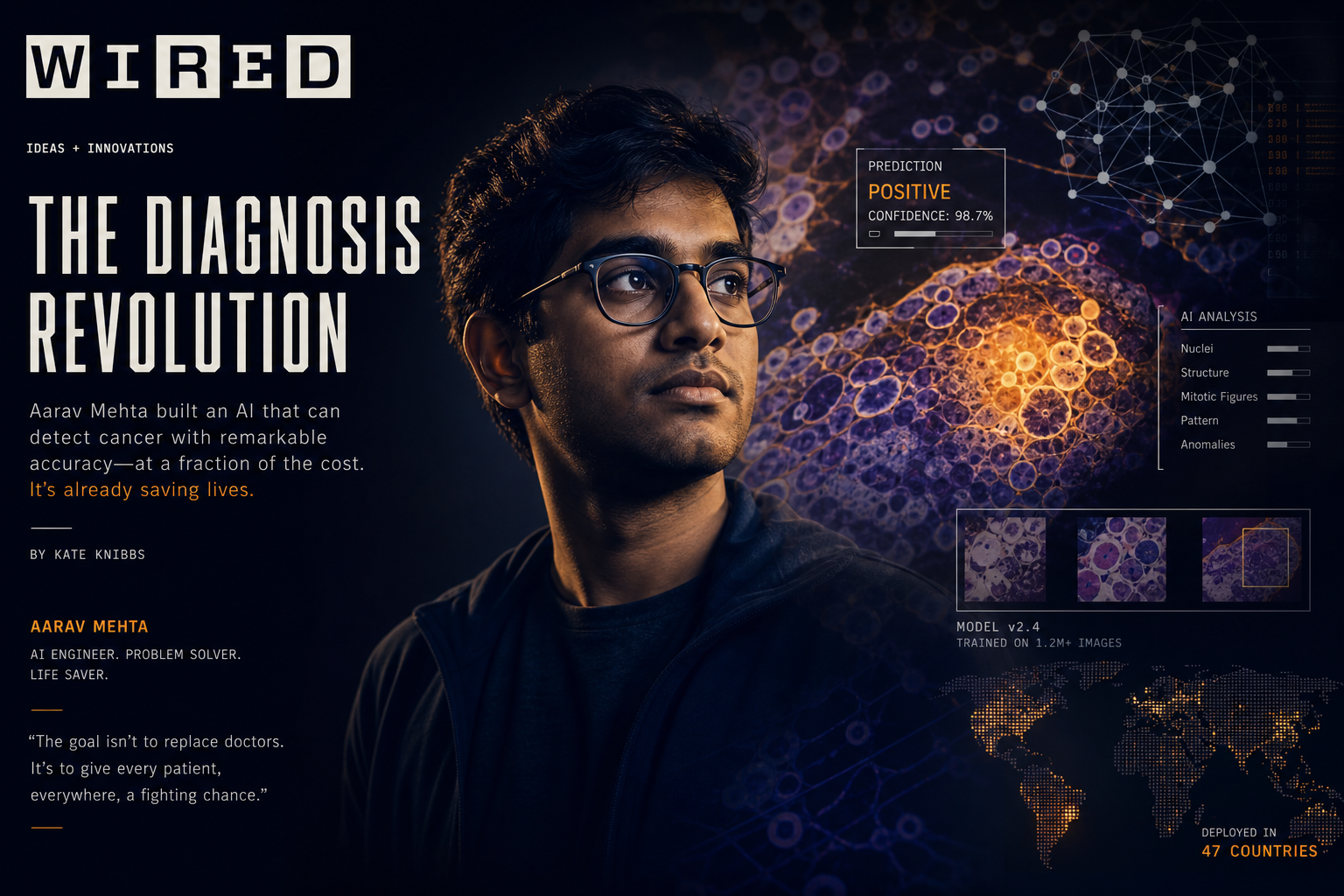
Aarav Mehta Built an AI Pathology System at 26 — And It Is Already Saving Lives
Aarav Mehta was halfway through his third year of a computer science PhD at IIT Bombay when he got a call that changed his trajectory. A radiologist uncle mentioned, almost offhandedly, that cancer misdiagnosis rates in tier-2 Indian cities ran above 30% — not because of incompetence, but because a single pathologist was sometimes responsible for reviewing 400 slides a day. Aarav saw a problem he could solve.
Two years later, his company PathAI India — distinct from the American company of the same name — has deployed its slide-analysis system in 14 hospitals across Maharashtra and Gujarat, reviewed over 280,000 biopsy slides, and flagged 1,200 cases for urgent oncologist review that had initially been marked routine. Seven of those were stage-1 cancers that, caught earlier, drastically improved patient outcomes.
“I Had No Idea What I Was Getting Into”
Aarav is disarmingly candid about the early days. “I thought I could train a decent CNN on the TCGA dataset, get to 90% accuracy, and hospitals would line up. That is absolutely not what happened.”
The first roadblock was staining variability. Histology slides are treated with haematoxylin and eosin (H&E) dyes, but different labs use slightly different protocols, different scanner hardware, and different storage conditions. A model trained on slides from a Mumbai teaching hospital generalised poorly to slides from a community lab in Nashik. Aarav spent eight months on domain adaptation — essentially teaching the model to see past the dye artifacts and focus on cell morphology.
“We ended up using a modified vision transformer with a contrastive pre-training phase on 2.3 million unlabelled slides. That was the breakthrough. The model learned representations that were stain-invariant by default, so fine-tuning on any new lab took maybe 200 annotated slides instead of 5,000.”
The Regulatory Maze
Building the model was, he says, the easier part. Getting regulatory approval from the Central Drugs Standard Control Organisation (CDSCO) took 18 months and three iterations of clinical validation. “Every time we submitted, there was a new committee who had not seen AI medical devices before. We essentially had to educate the regulators while simultaneously proving our system was safe.”
PathAI India’s system is classified as a decision-support tool, not a diagnostic device — a distinction that matters enormously. It flags slides for human review, highlights regions of interest, and provides a confidence score, but the pathologist always makes the final call. This design choice was partly regulatory pragmatism and partly genuine belief: “AI should augment experts, not replace them. The moment you position it as a replacement, you lose the trust of the very people you need to adopt it.”
What the Tech Stack Looks Like
The production system runs on AWS, using spot instances for batch slide processing (cost reduction of ~62% vs on-demand) and reserved instances for the real-time API that pathologists interact with. The model itself is a 400M parameter vision transformer fine-tuned from a foundation model pre-trained on pathology images from the Cancer Genome Atlas and several European biobank datasets.
Each whole-slide image averages 2–4 GB. Processing a single slide takes approximately 90 seconds end-to-end: ingest, tile extraction at 40x magnification, model inference on 512×512 patches, attention-map aggregation, and report generation. “The tiling pipeline was a nightmare to optimise. We went through four iterations before we got latency low enough that pathologists wouldn’t give up waiting.”
Next: Beyond Cancer
Aarav is already thinking about expansion. His current focus is extending the system to kidney and liver disease, which share similar slide-analysis workflows but have been largely ignored by Western AI-pathology companies because the market is smaller. He is also in conversations with three African health NGOs about deploying in low-resource settings where a pathologist may serve hundreds of thousands of patients.
“The thing that keeps me going is the specificity of the impact,” he says. “Software usually helps at scale but in abstract ways. With this, I can tell you the name of a patient whose cancer we caught earlier. That is a different kind of motivation.”
Aarav is currently raising a Series A of $8M and is looking to hire ML engineers with medical imaging backgrounds. If that sounds like you, the company’s website is pathai.in.