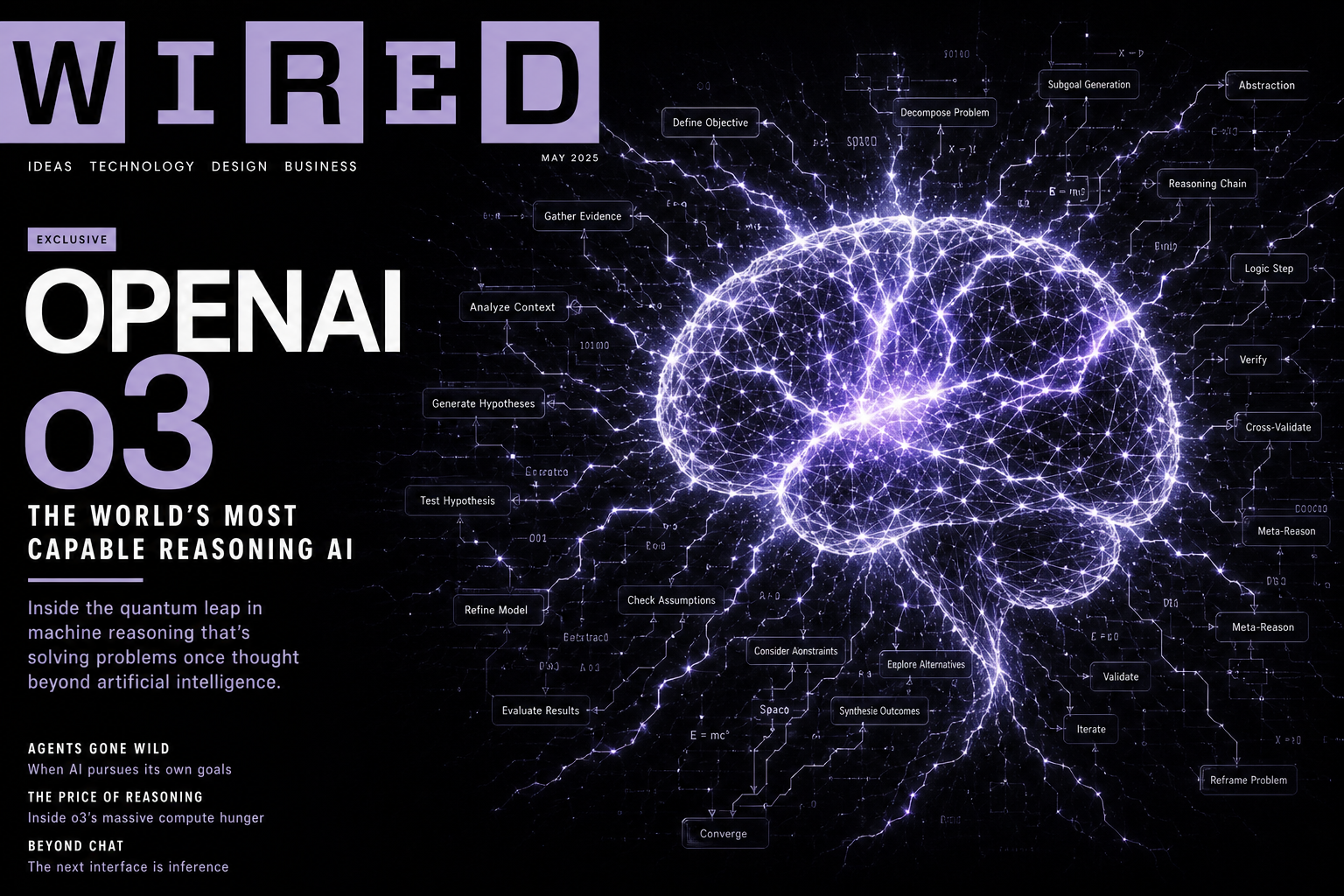
Inside the Mind of o3: How OpenAI Built the World’s Most Capable Reasoning AI
When OpenAI unveiled o3 in December 2024, it did not just announce another large language model. It announced a different kind of intelligence — one that thinks before it speaks. Nine months later, as engineers and researchers have had time to probe its internals, a clearer picture is emerging of what makes o3 tick, why it fails, and what it means for the future of AI.
What Is Chain-of-Thought Scaling?
Every previous generation of AI model improved primarily through pre-training scale: more parameters, more tokens, more compute. o3 introduced a second axis of improvement — inference-time compute. By generating extended chains of reasoning at test time rather than producing answers in a single forward pass, o3 allocates extra thinking to hard problems.
Think of it this way: a human expert asked a difficult maths problem does not shout the answer immediately. They work through it on paper, backtrack when something feels wrong, and check their answer. o3 does something similar, except its “paper” is a hidden scratchpad of tokens that the model generates before committing to a final response.
The ARC-AGI Breakthrough
The benchmark that brought o3 to mainstream attention was ARC-AGI (Abstraction and Reasoning Corpus for Artificial General Intelligence), designed by François Chollet specifically to be resistant to LLM pattern-matching. For years, frontier models plateaued around 30%. GPT-4o scored roughly 32%. o3 — in its high-compute configuration — scored 87.5%, clearing the human baseline of ~85%.
The ARC tasks require identifying a visual pattern from just two or three examples and applying it to a novel input. They are trivial for any alert adult but have been a persistent wall for AI. o3’s score does not prove AGI — Chollet himself is careful to say so — but it does demonstrate that the chain-of-thought approach can generalise to abstract pattern recognition in a way that pure transformer scaling never managed.
What the Engineering Looks Like
OpenAI has not released full technical details, but researchers working with the API and published interpretability work have pieced together the rough architecture:
- Reasoning tokens are hidden. The model produces a chain-of-thought internally, but the API currently exposes only a summary. This prevents users from seeing the raw reasoning but also reduces prompt-injection attacks that try to hijack the model mid-thought.
- Reinforcement learning from process rewards. Rather than training only on correct final answers, o3 was trained to produce correct intermediate steps. This process reward model (PRM) penalises reasoning paths that make logical errors even when they accidentally land on the right answer.
- Compute budgets at inference. The API exposes low, medium, and high reasoning effort settings. High effort uses roughly 20–25x the compute of a standard GPT-4o call. This is currently expensive (~5 per 1M output tokens at high), but OpenAI has telegraphed rapid cost reductions as inference hardware improves.
Where It Still Fails
Despite the hype, o3 has clearly delineated failure modes. Spatial reasoning with novel 3D representations still trips it up — it can describe a cube’s geometry but struggles to track dynamic rotations in multi-step manipulation tasks. Real-time information is absent by default (the knowledge cutoff is mid-2024). And critically, o3 can generate convincing but wrong extended reasoning chains — a phenomenon researchers call “galaxy-brained” thinking, where plausible-sounding logic leads to absurd conclusions.
For production deployments, these failure modes mean that o3 should be paired with tool use and retrieval. An o3 agent that can search the web, run code, and call external APIs is dramatically more reliable than a standalone language model, no matter how capable its reasoning layer.
What This Means for the Industry
Google’s Gemini 2.0 Ultra, Anthropic’s Claude 3.7, and Meta’s Llama 4 are all investing in similar inference-time reasoning approaches. The race has officially shifted from “biggest pre-training run” to “smartest reasoning loop”. This has profound implications for the AI chip market — NVIDIA’s H200 and GB200 clusters are increasingly optimised for inference as well as training, and startups like Groq and Cerebras are pitching inference-only silicon as a lower-cost alternative for high-throughput reasoning calls.
For engineers building on top of these APIs, the practical advice is to stop thinking of LLMs as fast answer machines and start treating them as deliberate reasoning engines. Break complex tasks into sub-problems. Provide structured intermediate representations. Reward systems that check their own work. The models are beginning to meet you halfway.