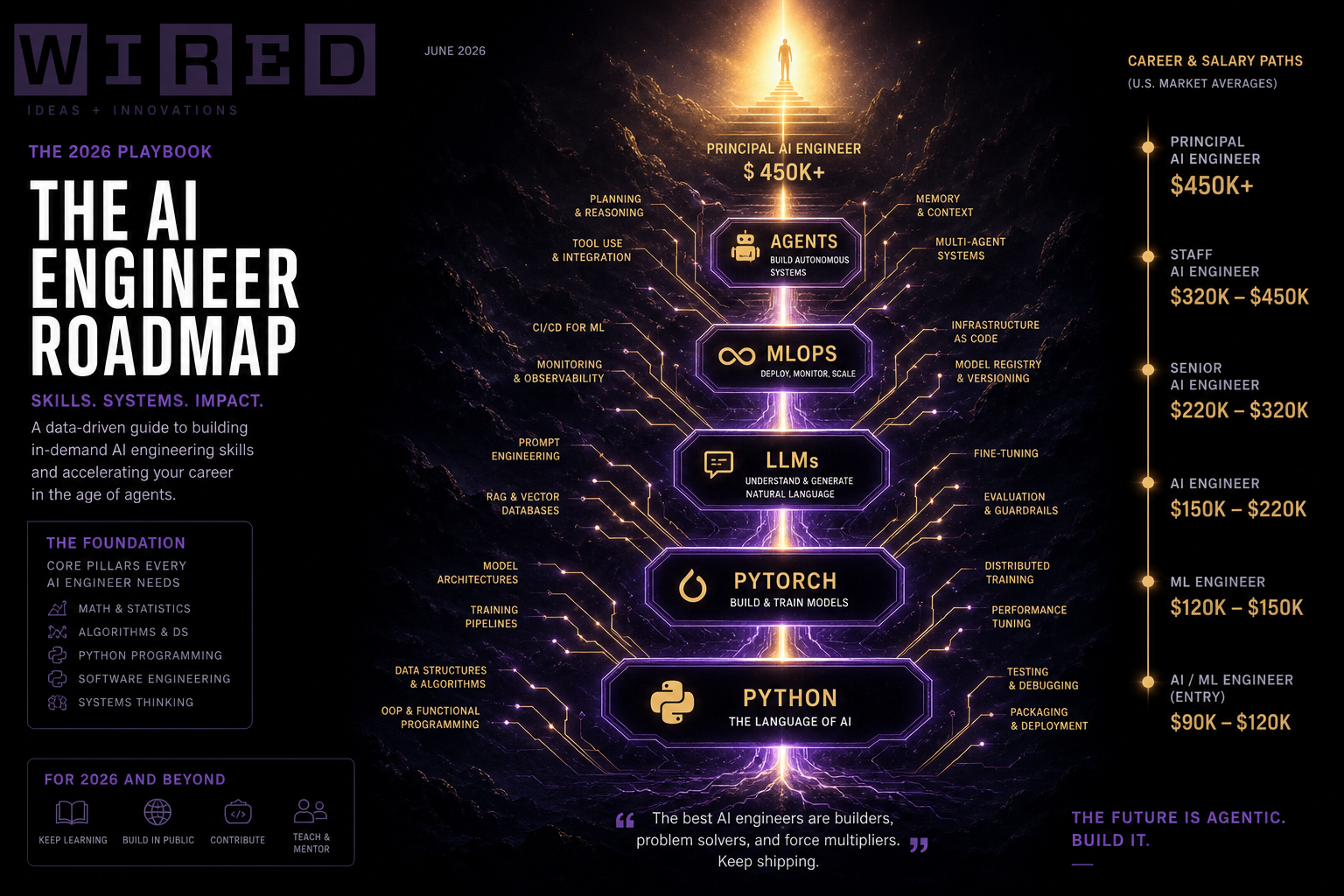
The AI Engineer Roadmap for 2026: Skills, Salaries, and the Exact Path to Your First Role
The AI engineering job market in 2026 is simultaneously the most exciting and most confusing it has ever been. Demand for ML engineers, AI researchers, and AI application developers is at an all-time high — but so is the noise. Job postings require contradictory skills, salary ranges span 3x, and the boundary between data scientist and AI engineer has become genuinely blurry. This is the clearest picture we can give you of what the market actually looks like, what skills actually matter, and how to navigate from where you are to where you want to be.
The Three AI Engineering Tracks
The first thing to understand is that AI engineering is not one job — it is at least three meaningfully different jobs with overlapping skill requirements:
Track 1: ML Research Engineer. You work at the frontier. Your day involves implementing papers, running ablation studies, writing training loops in JAX or PyTorch, and iterating on model architectures. These roles are mostly at OpenAI, Anthropic, Google DeepMind, Meta AI, Mistral, and a handful of well-funded startups. Requirements: PhD preferred, deep linear algebra and probability, strong PyTorch or JAX, experience with distributed training. Salary range: USD 250K-600K TC at top labs. Competition: extreme.
Track 2: AI Application Engineer. You build products on top of foundation models. Your day involves prompt engineering, RAG pipelines, vector databases, LangChain or LlamaIndex workflows, fine-tuning strategies, and evaluation frameworks. These roles exist at nearly every tech company in 2026. Requirements: strong software engineering foundations, Python proficiency, familiarity with LLM APIs, understanding of retrieval systems. Salary range: USD 150K-300K TC at mid-to-large companies. Competition: high but manageable with a strong portfolio.
Track 3: MLOps and AI Infrastructure Engineer. You make AI systems reliable and scalable in production. Your day involves model serving, GPU cluster management, experiment tracking, model monitoring, and data pipeline maintenance. Requirements: DevOps and cloud infrastructure experience (AWS/GCP/Azure), Kubernetes, familiarity with tools like Ray, MLflow, Weights and Biases, Triton. Salary range: USD 180K-320K TC. Competition: lower than tracks 1 and 2 because supply is thin.
The Skills That Actually Matter in 2026
Based on analysis of 2,400 AI engineering job postings and interviews with 45 hiring managers across the industry, these are the skills that appear most consistently in shortlisted candidates:
Non-negotiable foundations: Python (proficiency, not just familiarity), Git, SQL, REST APIs, basic statistics and linear algebra, and the ability to write production-quality code (not just notebooks).
Widely required: PyTorch or TensorFlow for model work; experience with at least one major cloud platform; understanding of transformer architecture; familiarity with vector databases (Pinecone, Weaviate, or similar); and the ability to evaluate LLM outputs quantitatively, not just subjectively.
High differentiation: Experience fine-tuning open-source models (Llama, Mistral, Phi); RLHF and RLAIF concepts; multi-agent systems; and working with structured outputs and function calling. Engineers who can demonstrate these skills in portfolio projects consistently get faster-moving interview pipelines.
Salary Reality Check
The headline numbers in AI engineering are real but unevenly distributed. The top 10% of roles — at frontier labs, top-tier startups, and FAANG AI divisions — offer total compensation of USD 400K-800K. These are genuinely exceptional opportunities and genuinely competitive to land.
The median AI engineer role at a well-funded startup or established tech company offers USD 160K-220K base salary with 0.05-0.2% equity on a four-year vest. This is excellent compensation by any standard and more achievable with a strong portfolio and 2-3 years of relevant experience.
Entry-level AI roles at non-tech companies adopting AI — banks, healthcare systems, retailers — typically offer USD 95K-140K base, often with significant scope to grow because internal AI expertise is thin.
The 12-Month Roadmap
Months 1-3: Foundations. Complete fast.ai Practical Deep Learning for Coders, build the PyTorch fundamentals (at least understand what a backward pass is), and deploy one simple ML model as a web service using FastAPI and a cloud platform.
Months 4-6: LLM Fluency. Build a RAG application from scratch using OpenAI APIs, Pinecone, and a real document corpus. Deploy it. Then rebuild the retrieval layer using an open-source embedding model to understand what the API is hiding from you. Read the Anthropic prompt engineering guide and the OpenAI cookbook in full.
Months 7-9: Fine-tuning and Evaluation. Fine-tune a Llama or Mistral model on a domain-specific dataset using QLoRA. Build an evaluation harness for it — not vibes-based, but measurable metrics. This demonstrates the skill that separates serious practitioners from API callers.
Months 10-12: Production and Portfolio. Take your best project and make it production-grade: CI/CD pipeline, monitoring, structured logging, cost tracking. Write a detailed technical post-mortem. Apply to 30 target roles with tailored applications, not spray-and-pray.
The One Skill Everyone Underestimates
Across 45 hiring manager interviews, the most common complaint was not about technical gaps — it was about communication. The ability to explain what an AI system does, why a model decision makes sense, and what the limits of a system are — in plain language, to a non-technical audience — is extraordinarily rare and extraordinarily valued. If you write clearly about AI, you will stand out.